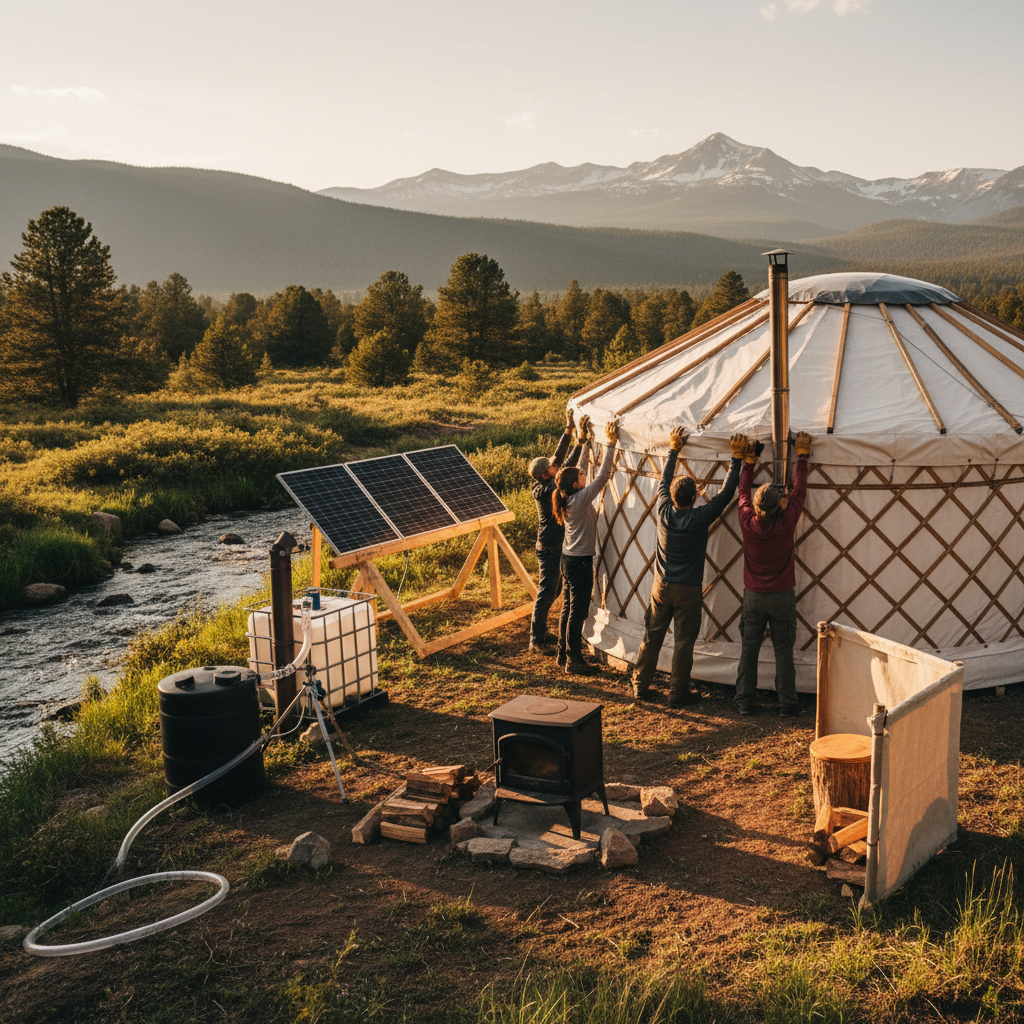
Going off-grid in a yurt is one of the most achievable ways to live independently on raw land. The structure is light, the footprint is small, and the systems you need are simpler than a conventional house. Here is how the four core systems come together.
Sizing Your Solar Power System
Most off-grid yurt owners land somewhere between 1,200 and 3,000 watts of panels. A weekend or seasonal yurt with LED lighting, a laptop, a water pump, and phone charging runs comfortably on 800–1,200 watts. Full-time living with a refrigerator, well pump, and small appliances usually needs 2,000 watts or more paired with a lithium battery bank of 5–10 kWh.
- Panels: ground-mounted arrays are easier to clean, angle seasonally, and service than roof mounts, and yurt rafters are not designed to carry racking loads.
- Batteries: LiFePO4 handles cold better than lead-acid and tolerates deeper discharge.
- Inverter: size for your largest simultaneous load, not your total load.
Water: Hauling, Wells, and Catchment
Water is usually the deciding factor for a site. Hauling water into a 300–500 gallon cistern is the lowest-cost start and works well for seasonal use. A drilled well is the long-term answer for full-time living, but budget for both the drilling and the pump and pressure tank. Roof catchment from a yurt is possible but modest — the round roof sheds cleanly, though gutter systems require custom work and rainwater harvesting is regulated differently state to state.
Whatever the source, plan for freeze protection: bury supply lines below frost depth, insulate anything that runs under the deck, and keep a heat trace circuit on exposed runs.
Heating Without a Grid Connection
A small wood stove is the classic yurt heat source and still the most efficient. In a well-insulated 24′ or 30′ yurt, a stove rated for 800–1,200 square feet holds temperature comfortably through a Colorado winter. Pair it with a propane wall heater as backup for overnight and shoulder seasons so you are not feeding the stove at 3 a.m.
Insulation matters more than stove size. Upgraded reflective insulation packages, an insulated floor system, and snug-fitting door and window seals will cut your fuel use dramatically.
Waste and Greywater
Composting toilets are the most common off-grid choice and avoid a septic permit in many jurisdictions — but not all. Greywater from sinks and showers typically routes to a gravel infiltration bed or a simple mulch basin. Check county rules first; greywater is regulated separately from blackwater in most states.
Permitting: Ask Before You Order
Call your county planning department early. Ask specifically whether a yurt is classified as a temporary structure, a recreational structure, or a permanent dwelling in your zone, and whether that classification changes if you put it on a permanent foundation or connect utilities. The answer shapes your deck, your anchoring, and sometimes your site.
Putting It Together
Build in stages. Get the platform and yurt up, live in it seasonally with hauled water and a wood stove, then add solar and permanent water as budget allows. Nearly every successful off-grid yurt we have shipped followed that sequence rather than trying to finish everything in one season.